BNSF Seattle in HO Scale

gregamer

Feb 202012
 

Progress

I started benchwork today. I’m using angle brackets from Home Depot; 16″ brackets along the east wall and 12″ brackets along the south and west walls. Sitting atop the brakets is a 1×3 pine ledger board that I cut down to 2″. I also cut 2×3 boards down to 2″ to mount to the brackets.  The brackets are mounted to the studs using 2″ lag screws. Some of the brackets required shims to keep them level. The ledger board is screwed down with 1 5/8″ self tapping self setting screws.

I painted the ledger boards white. I plan to paint the complete underside of the benchwork. Not really worried about warping, I just want a nice clean looking surface below (of course it probably would have helped had I used nicer wood.)

Problems

  1. I over tensioned one lag screw to the point that it snapped the head off.
  2. I ran out of lag screws and had to go back to Home Depot mid-day for more.
  3. I hit an existing hole or maybe a knot hole in one stud and couldn’t get a good grip for the lag screw. To make things worse, the second lag screw hit a nail stop. I had to move that bracket.

Using Scrap

  1. I’m using as much “scrap” wood as I can. I always have extra boards lying around and I want to use them up.
  2. I’ll be using as much “scrap” paint as I can. That’s where I’m getting the “white” paint for the underside of the layout.
  3. I’ll be using as much “scrap” hardware as I can. I had to buy the 2″ lag bolts, the 3″ ones I already have were overkill.

What’s Next?

I need to cut two more boards to move on to the west wall. I’ll be placing two brackets on the west wall and spanning a six foot window with the ledger board and a parallel block to help stabilize this section.

The east and south walls have all brakets and ledgers in and will next mount wood to the brackets. I have these cut and predrilled, but they aren’t as pretty as I’d like them to be, I may need to do some new boards for this.

Feb 172012


Painting the walls and ceilings. I’ve had really good one coat experiences with Behr Ultra, but this light color is taking 2-3 coats. Eventually I’ll remove everthing from the closet, including the work desk, repaint and build a more sturdy work bench.

Feb 142012
 

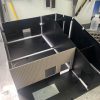
Pre-construction photos taken February 14, 2012. I have just filled in some old screw holes with spackle. I’m still working on cleaning out the room before painting.

Feb 142012
 
Behr 730E-1 Polar White

Behr 730E-1 Polar White

To reflect the wet and cold Seattle skies I want a color that looks muted and grayish. I chose Behr Polar White #730E-1. I bought one gallon of Behr Ultra Interior Ceiling paint for the ceiling, walls and sky boards this color. I like to spend the extra $10 bucks for the Ultra because it’s usually a one affair. I’ve learned my lesson with cheap paints that can take several coats to get a good even finish.

I went to home depot to choose a color, but Behr also has an online color picker.

I also picked up some spackle to work on a little hole filling before I start dinging the wall up again.


Operations

I spent the early part of the day entering data into Easy Model Railroad Inventory. It has a lot of fields, to help you keep an extremely detailed record of your equipment. I entered a dozen freight cars and one locomotive. I spent a good deal of time entering consignees and shippers for the Operations features of EMRI. When I got a decent set of data, I couldn’t figure out how to print up a simple track list, I couldn’t figure out how to even get the cars in to a track. I don’t think it’s designed down to that level of operations detail. Quite honestly it’s a great program for keeping track of your rolling stock, but I don’t think it’s going to fit my operations needs.

Minimum Turnouts & Minimum Radii

Tonight I was thinking about minimum turnouts and radii. This is where I need to do some operating. I’ve designed everything with #6 turnouts and 24″ minimum radius, but I really don’t know what HO trains look like running on a #6 turnout. I know in N-Scale the #8s and #10′s look right, everything else looks too small. With these thoughts I designed an alternative Industrial Lead to use #8 turnouts and 28″ minimum radius.  This of course means fewer car spots & less yard space. Am I being too ridiculous when it comes to these minimums. The real answer I guess will come when I actually get some trains on a track and test this out.

Clean Up Progress

I’ve told myself I have to clean up the train room and lighten the train load before I start a new layout. I’ve listed and sold 226 auctions on ebay during the last two months. I have another 4 items for sale now and one tote left to sell.

I’ve consolidated the crap from my workbench (that never got used as a workbench) and placed most of it inside a new roller cabinet. I’ve consolidated all of my scenery stuff into a tote and placed it in the garage. I’ve finished glueing scenery and buildings to my N Scale Alaskan Shipping FreemoN Module and it’s going to the garage in the morning. When I get a pair of strong hands I’m moving the workbench to the work garage and the work desk (that never gets used as a work table) is being sent back to the Goodwill.

Next Steps

  • Finish clean up and reorganization of storage.
  • Finish sales.
  • Remove closet shelving.
  • Fix closet desk (it’s droopy).
  • Spackle holes in wall.
  • Paint room.
  • Build layout.

Track Plan 22 - Alternative Plan #8 Turnouts & 28″ Minimum Radius

Track Plan - Industrial Lead 22 Alternative Plan

Track Plan - Industrial Lead 22 Alternative Plan


Track Plan - Industrial Lead 20

Track Plan - Industrial Lead 20

I’d like to have two full spots on the layout at anytime. One full spot at the industries and one full spot in the yard. A full industry spot is 214″, I only have 192″ of dedicated yard tracks. I don’t have enough yard space to store a full second spot.

I’ve tried different methods to extend yard space, but they all result in a shorter lead or S curves in the yard ladder. The lead is 92″, the longest yard track is 76″. With these lengths, I should be able to pull out the longest yard track and maybe foot-board one car.

Maybe a 2nd full spot isn’t necessary. I plan to run the operations with sure spots and a full pull and spot would probably never occur.


Operations:

How to play the Industrial Lead.

Session Start

  • Full or nearly full spot at PCC Logistics
  • Full spot at Cargill
  • Full or nearly full spot at Franz
  • Zero or one car on spot
  • Yard 1 full with corn syrup cars
  • Yard 2 full with boxes, hoppers, flats, reefers
  • Yard 3 full with boxes, hoppers, flats, reefers

Switching

  • Line up spots for PCC Logistics
  • Line up spots for Cargill
  • Pull Cargill
  • Set Pulls on Odom Lead
  • Pull and spot PCC Logistics
  • Pull and spot Cargill
  • Pull and spot Franz
  • Pull and spot Terminal 115

Some sessions will only spotting Cargill “the Hole”, which can be a wicked puzzle in itself.

Track Plan Changes

  • Slimmed bench-work. 14″ West. 16″ South.
  • #6 turnouts for yard ladder. old ladder used #5 turnouts
  • Code 70 track used beyond Cargill turnout.
  • Added cars to yard tracks to get a better idea of what fits where.
  • #5 turnout to Franz. Was #8 turnout.
  • Drew in slide out drawers (black rectangles). These will be for laying your switchlists on.

Switchlist Program

I’ve started working on a switch-list program. The initial database is written for Open Office. It’s OK, but not great (I like Access better). I can’t figure out how to store cars in a track yet. I’ve also started to look at using Easy Model Railroad Inventory. The program looks great for storing car data, but I need to learn the operations functions to see if they will do what I want.

Car Kind Codes

I’m thinking about using my own code for car types. It’ll be semi prototypical in that B is boxcar, C is covered hopper, F is flat car, T is tank car. But the next two characters will indicate length. For example T44 will be a 44 foot tank car. This is similar to the BNSF system which classifies by type, length and property (ex. T4I = Tank Car 40′-49′ Insulated). I think my new coding system will be most useful to operators looking to stash cars on the layout.

Feb 062012
 

I did pretty good at the UNW train show this year:

  • Atlas Trainman GP38-2 BN 2150 $45
  • 3 x Atlas PressureAide Hoppers $25
  • 3  x Atlas 17,600 Gallon Cornsyrup Tank Cars $36
  • 1 x Intermountain EJ&E 60′ Wood Deck Flat Car $20
  • 2 x die-cast semi tractors for $5 each.
  • Busch Ford Explorer for $7.
  • Noch Wildgrass $12
  • Silflor miniNatur weed tufts $7


I almost bought a GP39-2 for $80, luckily I found this GP38-2 for $45. It doesn’t have all the details, like grab irons, so I didn’t want to invest too much. I was hoping to find a BNSF flat car, but I settled for the EJ&E flat car. I really like the wood deck. This should work great for hauling my Norscott Loader.


Jan 312012
 
Container Shipment
Container Shipment

I took advantage of Walther’s container sale and bought a few dozen containers and a few chassis for use on the Industrial Lead layout. Twelve of the containers are reefers and will be used at PCC Logistics. Twelve are older style 40′ containers that will be used at Terminal 115. The remaining are various 20′ and 40′ containers for use around the layout.

 
I chose various names including OOCL, China Shipping, Maersk, Sea-Land, NYK, Hyundai, Hanjin, Triton, Capital, XTra, Cosco. These are all names I see around Seattle.
 
The order was fulfilled and shipped quickly. Thanks Walther’s.


It’s hard to let go of a dream. I abandoned my partially completed N Scale Halland Yard layout in November 2010, but I’ve been hanging on to the remnants every since. Hundreds of cars and buildings and electronics that will probably never be used by me again. 

I’ve told myself to clear away all the unused model train stuff before I get started building the new layout.  I need to scale down to scale up.

So in the past two weeks I’ve completed 165 eBay auctions, mostly N-Scale or DCC items. I made about $1700. I have more items to list, but I want to wait for a free listing day or until next month when I can list another 50 items for free. In the interim I plan on listing more items on this site and other off-eBay sites.

As for N scale, I am still going to participate with my N-Scale club. For the foreseeable future that will be limited to my O’Brien oNeTrak module and the associated locos and rolling stock. I’m also keeping the pricey and rare N building kits I’ve acquired (in case I ever build my N-Trak module) but I’m completely liquidating everything else from any era before the current era. I’m also getting rid of all the mish-mash hodge-podge stuff I was going to someday transform in to this or that.

I’m also liquidating a few HO items I have that won’t fit with The Industrial Lead layout.

This process has been very liberating. I am no longer beholden to the stuff I bought years ago to suit a purpose I no longer desire. Now I can focus on Now.


Jan 082012
 
Track Plan - Industrial Lead 13

Industrial Lead 13

Track Plan Updates
  • Moved Franz Bakery to the west side.
  • Moved the yard to the west side.
  • Rearranged Cargill turnout.
  • Rerranged PCC turnout.
  • Added a smll runaround.
  • Added industry Seaport Steel.
  • Added industry Terinal 115
  • Moved all shelves in to 18″ or 16″.
  • Eliminated Seattle Pottery.


Instead of detailing each iteration of the track plan, I’ve skipped ahead to Track Plan #13. This does stray some from the prototype track arrangements, but I think it’s as honest as can be given the space and desired industries.

I’ve added a runaround and two additional industries to make it more challenging. Seaport Steel is located on the South Leg of the West Seattle WYE. It takes falt cars with steel plates and shapes. Terminal 115 is located in West Seattle, at the end of the Avenue. It takes a lot of random specialty loads; including flat cars with machinery, flat cars with pipes.

I’ve decided it’d be best to keep the shelves under 18″. I had planned on modelling Seattle Pottery on the North side of the Hole tracks, but I decided it would be difficult to couple and uncouple cars with this building in the way. I still have PCC logistics in front of the tracks, but I think I’m willing to live with the difficulty of coupling and uncoupling here, because I ‘ll be mostly pulling and spotting the entire track at once.

I’ve moved the yard so it is next to Seattle lighting and moved the Odom Lead to function as an actual lead track. I think this arrangement gives me the optimum storage space and switching realism. In real life there is no yard and the Odom Lead is adjacent to Seattle Lighting and stubs out at Hanford Street.


© 2012 Greg Amer
The Industrial Lead
Suffusion theme by Sayontan Sinha